
General Dentistry in Bilekahalli, Bengaluru
General dentistry is the everyday care that keeps teeth and gums healthy: check-ups, X-rays, fillings for decay, and treatment for problems such as toothache and sensitivity. Finding a problem early usually means simpler, quicker treatment.
- Check-up
- 20–30 min
- Filling
- 1 visit, 30–60 min per tooth
- Anaesthesia
- Local, if needed
- Back to work
- Same day
What a check-up includes
- A conversation about any problems, your medical history and the medicines you take.
- An examination of your teeth, gums, tongue, cheeks and the rest of your mouth, including a check for early signs of mouth cancer. This matters especially if you smoke or chew tobacco, gutka or paan.
- Digital X-rays of the teeth if needed, taken here at the clinic, to see decay between the teeth and under fillings, and the bone around the roots.
- A clear explanation of anything we find and, if you need treatment, a written estimate before it starts.
When you might need treatment
- Toothache, or sensitivity to sweet, hot or cold.
- A hole or dark spot in a tooth, or food getting stuck between teeth.
- A broken tooth, or a filling that has fallen out.
- Bleeding gums: see professional teeth cleaning.
- A white or red patch, or an ulcer, in the mouth that hasn't healed in two weeks. Please have this checked promptly.
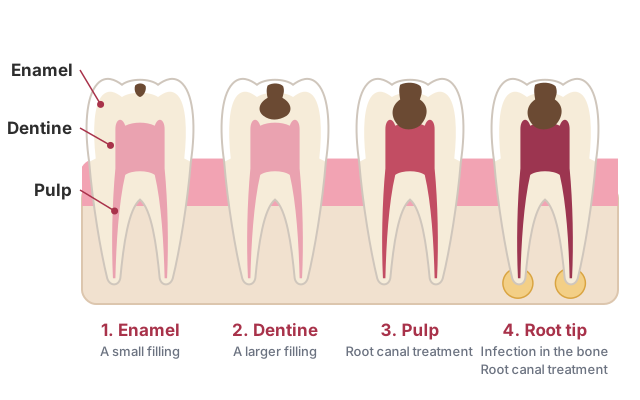
Your options for a decayed tooth
| Filling | Root canal treatment and crown | Removing the tooth | |
|---|---|---|---|
| When it's used | Decay that hasn't reached the nerve | Decay or infection that has reached the nerve | The tooth can't be saved |
| Keeps your own tooth | Yes | Yes | No |
| Visits | 1 | 3–5, including the crown | Usually 1 (a follow-up if stitches or graft material are placed), plus replacing the tooth |
The earlier decay is treated, the simpler and less expensive the treatment usually is. Read more about root canal treatment.
Types of filling
- Tooth-coloured (composite) fillings are bonded to the tooth and matched to its shade. They are used for most fillings in front and back teeth.
- Glass ionomer fillings release fluoride. They are often used near the gum line, in milk teeth, or as a temporary filling.
What happens, step by step
- Check-up and X-rays. We examine your mouth and take X-rays only if they are needed.
- Treatment plan and written estimate. If you need treatment, we explain the options and give you the fee in writing before starting.
- Numbing. For a filling, the tooth is numbed with local anaesthesia if needed.
- Removing the decay. The decayed part of the tooth is removed and the cavity is cleaned.
- Filling the tooth. Tooth-coloured filling material is placed in layers, hardened with a blue light, then shaped and polished to fit your bite.
- Preventing new decay. We suggest how to lower your risk: brushing twice a day with fluoride toothpaste, fewer sugary snacks and drinks between meals, and regular check-ups.
Possible risks
- Sensitivity to cold or biting for a few days or weeks after a filling, especially a deep one. It usually settles.
- A high bite that makes chewing uncomfortable. A quick adjustment fixes it.
- Decay closer to the nerve than it looked. A deep filling can still need root canal treatment later; we'll tell you if a tooth is at risk.
- Wear and chipping. Fillings wear over time and may need replacing.
- X-rays use a small dose of radiation. We take them only when needed, and digital X-rays need a low dose. Tell us if you are pregnant.
After your treatment
- Wait until the numbness wears off before eating or having hot drinks, so you don't bite or burn your cheek or tongue.
- Some sensitivity to cold is normal for a few days.
- If your bite feels high, call us for a quick adjustment.
- Brush twice a day with fluoride toothpaste and clean between your teeth every day.
Call us if the pain keeps getting worse, you notice swelling, or a filling breaks or falls out.
Beyond general dentistry
Some problems need more than a check-up or a filling. These are also looked after at Dantya Dental:
- Children's dentistry. Check-ups, fillings and advice for children, by our general dentists, and by a pedodontist (a dentist who specialises in children) when a child needs one. See children's dentistry.
- Esthetic dentistry. Whitening, bonding and veneers to change the colour or shape of teeth. See esthetic dentistry.
- Orthodontics (straightening teeth). A visiting orthodontist sees patients at the clinic. See braces and clear aligners.
- Oral surgery. A visiting oral and maxillofacial surgeon treats complex cases at the clinic, such as deeply buried wisdom teeth. See wisdom tooth removal.
- Dental implants. Replacing missing teeth with implants, planned by our prosthodontist. See dental implants.
Fees
The fee depends on the treatment you need; for a filling, its size and how many surfaces of the tooth it covers. You receive a written estimate after the examination, before treatment starts. Call or WhatsApp us if you'd like an idea of the cost.
Questions patients ask
How often should I have a check-up?
Usually every 6–12 months. People with a lot of fillings, gum problems or diabetes may need to come more often; people with healthy teeth and gums sometimes less often. We'll suggest an interval for you.
My tooth doesn't hurt. Do I still need a filling?
Decay usually doesn't hurt until it gets close to the nerve. Treating it while it is small means a smaller filling, and can avoid root canal treatment later.
Do I need an X-ray at every visit?
No. X-rays are taken when they are needed to find a problem or check areas we can't see, such as between the back teeth. How often depends on your risk of decay.
Should I replace my old silver fillings?
Not if they are intact and the tooth is healthy: removing a sound filling also removes some healthy tooth. We replace them if they are broken, leaking or have decay underneath, or if you would like a tooth-coloured filling for appearance.
Why is my tooth sensitive to cold after a filling?
It's common for a few days to a few weeks, especially after a deep filling, and usually settles. If it gets worse, or the tooth starts to ache on its own, call us.
Can I eat straight after a filling?
Tooth-coloured fillings are hard when you leave the clinic. Wait until the numbness wears off, so you don't bite your cheek or tongue.
What should I do if I have toothache?
Call us and we'll try to see you as soon as possible. Until then, you can take an over-the-counter painkiller that you have taken safely before, following the directions on the pack. If you're pregnant, take other medicines or have a health condition, check with your physician first. Don't put a tablet on the gum: it can burn it.
Location
Dantya Dental, 18, 1st Floor, 6th Main St, Thayappa Garden, Ramanashree Enclave, Bilekahalli, Bengaluru, Karnataka 560076
Near Racket Club of Bengaluru, close to IIM Bangalore. Easy to reach from BTM Layout, JP Nagar, Arekere and Bannerghatta Road.
Monday to Saturday, 10am–8pm. Sundays by appointment.
Related treatments
Reviewed by Dr. Yashashwini N Simha, MDS (Prosthodontics and Implantology), FICOI (NDC Reg. No. 38871-A) on 22 October 2026.
This page gives general information. Your dentist will advise what suits you after examining you.