
Teeth Cleaning (Scaling and Polishing) in Bilekahalli, Bengaluru
Professional cleaning removes hardened plaque (tartar, or calculus) and stains that a toothbrush can't. Regular scaling and polishing keeps the gums healthy, and a deeper cleaning below the gum line is the first treatment for gum disease.
- Visits
- 1; deep cleaning usually 2
- Time per visit
- 30–45 min
- Anaesthesia
- Usually none; local for deep cleaning
- Back to work
- Same day
- How often
- Usually every 6–12 months
When you might need it
You may need a cleaning if you notice:
- Gums that bleed when you brush or floss.
- Hard yellow or brown deposits on your teeth, often behind the lower front teeth.
- Bad breath that doesn't go away.
- Stains from tea, coffee, tobacco or paan.
- Red, swollen or receding gums, or teeth that feel loose: signs of gum disease.
Gum disease often causes no pain until it is advanced, so it is usually found at a check-up. It is more common in people who smoke or chew tobacco, people with diabetes and during pregnancy, so regular cleaning matters more for them.
Your options
| Scaling and polishing | Deep cleaning (scaling and root planing) | |
|---|---|---|
| What it treats | Tartar and stains above and just below the gum line; early gum inflammation (gingivitis) | Tartar deep under the gums and on the roots; gum disease with bone loss (periodontitis) |
| Anaesthesia | Usually none | Local, one area at a time |
| Visits | 1 | Usually 2 |
At the examination, we measure the space between the gum and each tooth (the gum pocket) to decide which you need. If gum disease is advanced, gum surgery may also be needed; we'll explain if this applies to you.
What happens, step by step
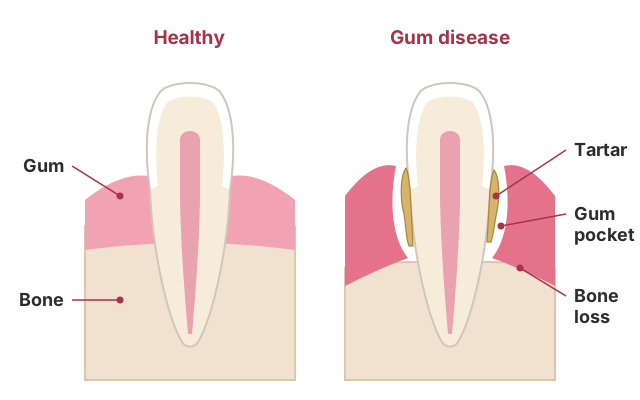
- Examination. We check your teeth and gums, measure the gum pockets, and take X-rays if needed to check the bone around the teeth.
- Scaling. An ultrasonic scaler loosens the tartar with vibration and a water spray, and fine hand instruments remove what is left. Sensitive areas can be numbed.
- Deep cleaning, if needed. For gum disease, the areas below the gum are cleaned and the root surfaces smoothed under local anaesthesia, usually over 2 visits.
- Polishing. The teeth are polished with a paste to remove stains and smooth the surface, so plaque sticks less easily.
- Advice. We show you the brushing and between-teeth cleaning that suit your mouth, and suggest when to come back.
- Review, after deep cleaning. After about 6–8 weeks, we measure the gum pockets again to check how the gums have healed.
Possible risks
Scaling is a routine procedure with few risks:
- Sensitivity to cold for a few days, because tartar that covered the tooth surface has been removed. A sensitivity toothpaste helps.
- Gums that bleed or feel sore for a day or two, especially if they were inflamed.
- Gaps between teeth looking bigger once tartar that filled them is removed and swollen gums shrink back. Cleaning doesn't create gaps or loosen teeth.
If you have a heart condition or a joint replacement, have diabetes, or take blood thinners, tell us before treatment so we can plan it safely.
After your treatment
- Mild sensitivity and slight bleeding are normal for 1–2 days.
- If your teeth feel sensitive, avoid very hot or cold food and drinks for a day.
- Brush twice a day with a soft toothbrush and fluoride toothpaste, and clean between your teeth every day with floss or interdental brushes.
- After deep cleaning, rinse as advised and keep the review appointment.
Call us if bleeding continues beyond 2–3 days, or if you notice swelling or pain that is getting worse.
Fees
The fee depends on how much tartar has built up and whether deep cleaning is needed. You receive a written estimate after the examination, before treatment starts. Call or WhatsApp us if you'd like an idea of the cost.
Questions patients ask
Does scaling loosen teeth or make gaps between them?
No. Tartar can fill the spaces between teeth and hide gum that has already shrunk back. Once it is removed and swollen gums settle, the gaps that were already there become visible, and the teeth may feel different for a few days. Teeth that are loose were loosened by gum disease, not by the cleaning; removing the tartar is part of treating it.
Does teeth cleaning hurt?
Most people feel vibration, a water spray and some scraping. If your teeth are sensitive or your gums are inflamed, we can numb the area.
Will cleaning make my teeth whiter?
Polishing removes surface stains from tea, coffee and tobacco, so teeth often look brighter. It doesn't change the natural colour of the teeth; that needs whitening.
How often should I have my teeth cleaned?
It depends on how quickly tartar builds up on your teeth and how healthy your gums are. Many people need a cleaning every 6–12 months; people with gum disease may need one more often. We'll suggest an interval for you.
Why do my gums bleed when I brush?
Bleeding gums are usually a sign of inflammation caused by plaque along the gum line (gingivitis). It can be reversed with a professional cleaning and daily brushing and cleaning between the teeth. Don't stop brushing the area.
Can I have a cleaning during pregnancy?
Yes, usually. Hormone changes make gums more likely to bleed and swell during pregnancy, so cleaning helps. Tell us you are pregnant; the middle three months are often the most comfortable time for treatment.
I have diabetes. Does that matter?
Yes. Gum disease is more common and can be more severe in people with diabetes, and treating it can help with blood sugar control. Let us know your recent sugar levels and the medicines you take.
Location
Dantya Dental, 18, 1st Floor, 6th Main St, Thayappa Garden, Ramanashree Enclave, Bilekahalli, Bengaluru, Karnataka 560076
Near Racket Club of Bengaluru, close to IIM Bangalore. Easy to reach from BTM Layout, JP Nagar, Arekere and Bannerghatta Road.
Monday to Saturday, 10am–8pm. Sundays by appointment.
Related treatments
Reviewed by Dr. Yashashwini N Simha, MDS (Prosthodontics and Implantology), FICOI (NDC Reg. No. 38871-A) on 22 October 2026.
This page gives general information. Your dentist will advise what suits you after examining you.