
Root Canal Treatment in Bilekahalli, Bengaluru
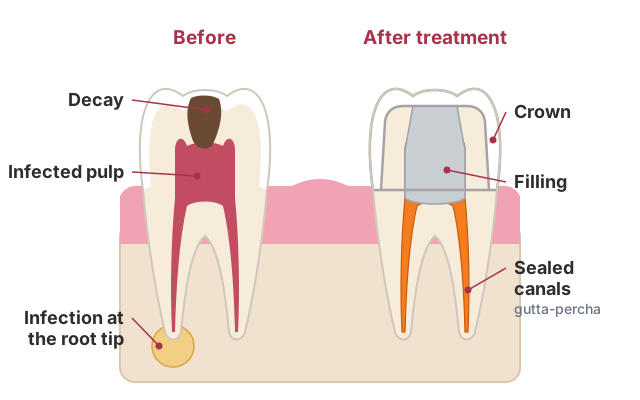
Root canal treatment saves a tooth whose nerve (the pulp) is infected or badly inflamed. The infected tissue is removed from inside the tooth, the root canals are cleaned and sealed, and the tooth is usually protected with a crown so you can keep chewing on it.
- Visits
- 1–3, plus the crown
- Time per visit
- 45–90 min
- Anaesthesia
- Local
- Back to work
- Varies; we'll advise you
When you might need it
You might need root canal treatment if you have:
- Severe toothache, especially when chewing or at night.
- Pain with hot or cold that lingers after the hot or cold is gone.
- Swelling of the gum or face near a tooth, or a pimple-like bump on the gum.
- A tooth that has turned darker after an injury.
- Deep decay or a crack that has reached the nerve.
Sometimes there are no symptoms at all, and the infection is found on an X-ray at a check-up. Before recommending treatment, we confirm the diagnosis with an examination, tests of how the tooth responds, and an X-ray. If a crack is suspected that doesn't show on these X-rays, a 3D X-ray (CBCT scan) may be advised; we refer you to a scan centre for it.
Your options for an infected tooth
| Root canal treatment | Removing the tooth | |
|---|---|---|
| Keeps your own tooth | Yes | No |
| Visits | 1–3, plus 2 for the crown | Usually 1 (a follow-up if stitches or graft material are placed) |
| Gap to fill afterwards | No | Usually: an implant, bridge or denture |
Not every tooth can be saved. If it is badly broken down, cracked below the gum, or has lost too much of the bone around it, removing it may be the better choice. We'll tell you what we find and explain the options before you decide.
What happens, step by step
- Examination and X-ray. We examine the tooth, check how it responds to cold and tapping, and take a digital X-ray of the tooth here at the clinic, with a digital sensor (RVG), to see the roots and how far the infection has spread.
- Treatment plan and written estimate. You receive the number of visits and the total fee, including the crown if one is needed, in writing before treatment begins.
- Numbing and isolation. The tooth is numbed with local anaesthesia. A thin rubber sheet (a rubber dam) is placed around it to keep it clean and dry and to stop fine instruments and rinsing solutions from going into your mouth.
- Cleaning the canals. A small opening is made in the top of the tooth. The infected pulp is removed, the length of each canal is measured, and the canals are cleaned, shaped and disinfected with fine instruments and rinsing solutions.
- Sealing the canals. The canals are filled with a rubber-like material (gutta-percha) and a sealer. If more than one visit is needed, a medicine is placed inside the tooth and it is closed with a temporary filling until the next visit.
- Restoring the tooth. The opening is closed with a filling. A back tooth usually needs a crown, fitted at a later visit, to protect it from cracking.
Possible risks
Root canal treatment is a routine procedure, but like any treatment it carries some risks:
- Tenderness or a flare-up for a few days after a visit, occasionally with swelling, managed with medicines.
- A fine instrument breaking inside a canal. Canals can be narrow and curved. The fragment can sometimes be removed or bypassed; if not, it may be sealed in and the tooth monitored.
- Infection that persists or returns, which may need the treatment redone, a minor procedure at the root tip, or removing the tooth.
- The tooth cracking, especially a back tooth that isn't protected with a crown.
- Hidden cracks or extra canals found only once treatment begins, which can change the plan. We'll tell you straight away if this happens.
We go through the risks that apply to your tooth before you decide.
After your treatment
- The tooth may feel tender for a few days, especially when biting. Take the medicines prescribed as directed.
- Don't eat until the numbness has worn off, so you don't bite your cheek or tongue.
- Avoid chewing hard food on the tooth until the final filling or crown is fitted. A temporary filling, and a root-filled tooth without a crown, can break.
- If antibiotics were prescribed, finish the course.
- Brush and floss as usual, and keep your appointment for the crown.
Call us if swelling increases, you develop a fever, the pain is getting worse rather than better after 2–3 days, or the temporary filling falls out.
Fees
The fee depends on the tooth (molars have more canals), how narrow or curved the canals are, the number of visits and the type of crown. You receive a written estimate after the examination, before treatment starts. Call or WhatsApp us if you'd like an idea of the cost.
Questions patients ask
Does root canal treatment hurt?
The tooth is numbed with local anaesthesia, so for most people the procedure feels much like having a filling. The tooth is often tender for a few days afterwards; this is managed with the medicines we prescribe.
Can it be done in one visit?
Sometimes. If the infection is limited and the canals can be cleaned fully, treatment can be finished in a single visit. A tooth with a lot of infection or swelling, or with narrow or curved canals, usually needs two or three visits.
Do I need a crown afterwards?
Usually, for back teeth. A root-filled premolar or molar can become brittle and crack under chewing forces, and a crown covers and protects it. A front tooth with little damage can sometimes be restored with a filling alone.
Wouldn't it be simpler to remove the tooth?
Keeping your own tooth is usually better when it can be saved. A removed tooth leaves a gap that generally needs an implant, bridge or denture, otherwise the neighbouring teeth can drift. We'll explain both options and what each costs.
Can antibiotics cure the infection instead?
No. Antibiotics can help control swelling that is spreading, but they can't clear the infection inside the tooth. The source has to be removed, either by root canal treatment or by taking the tooth out.
How long will the treated tooth last?
With a good seal, a crown where needed and regular check-ups, a root-filled tooth can last many years. It can still get new decay, crack or be affected by gum disease, so clean it like your other teeth.
Why are X-rays taken during treatment?
X-rays show the number, length and shape of the canals and confirm they have been filled to the right length. We use digital X-rays, which need a low dose of radiation. Tell us if you are pregnant.
What if the tooth hurts again months later?
Occasionally a treated tooth becomes infected again, for example if a canal was very narrow or the seal leaks. It can often be treated again; sometimes a minor procedure at the root tip or removing the tooth is needed instead.
Location
Dantya Dental, 18, 1st Floor, 6th Main St, Thayappa Garden, Ramanashree Enclave, Bilekahalli, Bengaluru, Karnataka 560076
Near Racket Club of Bengaluru, close to IIM Bangalore. Easy to reach from BTM Layout, JP Nagar, Arekere and Bannerghatta Road.
Monday to Saturday, 10am–8pm. Sundays by appointment.
Related treatments
Reviewed by Dr. Yashashwini N Simha, MDS (Prosthodontics and Implantology), FICOI (NDC Reg. No. 38871-A) on 22 October 2026.
This page gives general information. Your dentist will advise what suits you after examining you.